
Huron County Arrest Records and Court Charges
A Huron County arrest record documents an arrest itself. It notes who was taken in, the arresting agency, the date, and the booking that followed. In most cases the sheriff or a local police force makes the arrest. An arrest alone does not prove guilt. Soon after, a prosecutor reviews the facts and decides what to file. Those formal accusations are the court charges. Once filed with the court, they become the charge record, and that record follows the case from start to finish.
The two records sit on different sides of the system. Arrest and booking detail belong to the jail and sheriff side, and the county jail roster and custody rules are covered on the Huron County inmate records page. The court charges after arrest belong to the court file, where the clerk tracks each count and its status. Hearings, pleas, and the final result sit in the larger case file. For the complete criminal case file and sentencing, the Huron County criminal court records page carries that detail.
Find Huron County Arrest Records and Charges
Charges are read through the court case index, not through a public booking blotter. Michigan runs a statewide case search that covers Huron County cases. A name or a case number pulls the case, and the charge list sits inside it. Booking and custody detail are separate. The county does not post a public arrest blotter or mugshot database online, so the court index is the place to confirm what was actually charged.
- Open the Michigan MiCOURT case search and choose Huron County.
- Search by defendant name, or enter the case number when you already know it.
- Open the matching case and read the full list of charges.
- Check each charge for its statute code, its level, and its current status.
Arrest paperwork that is not part of the court file can be requested from the county through the Huron County Sheriff's Office. The sheriff's records office handles public records requests for arrest reports and similar documents.
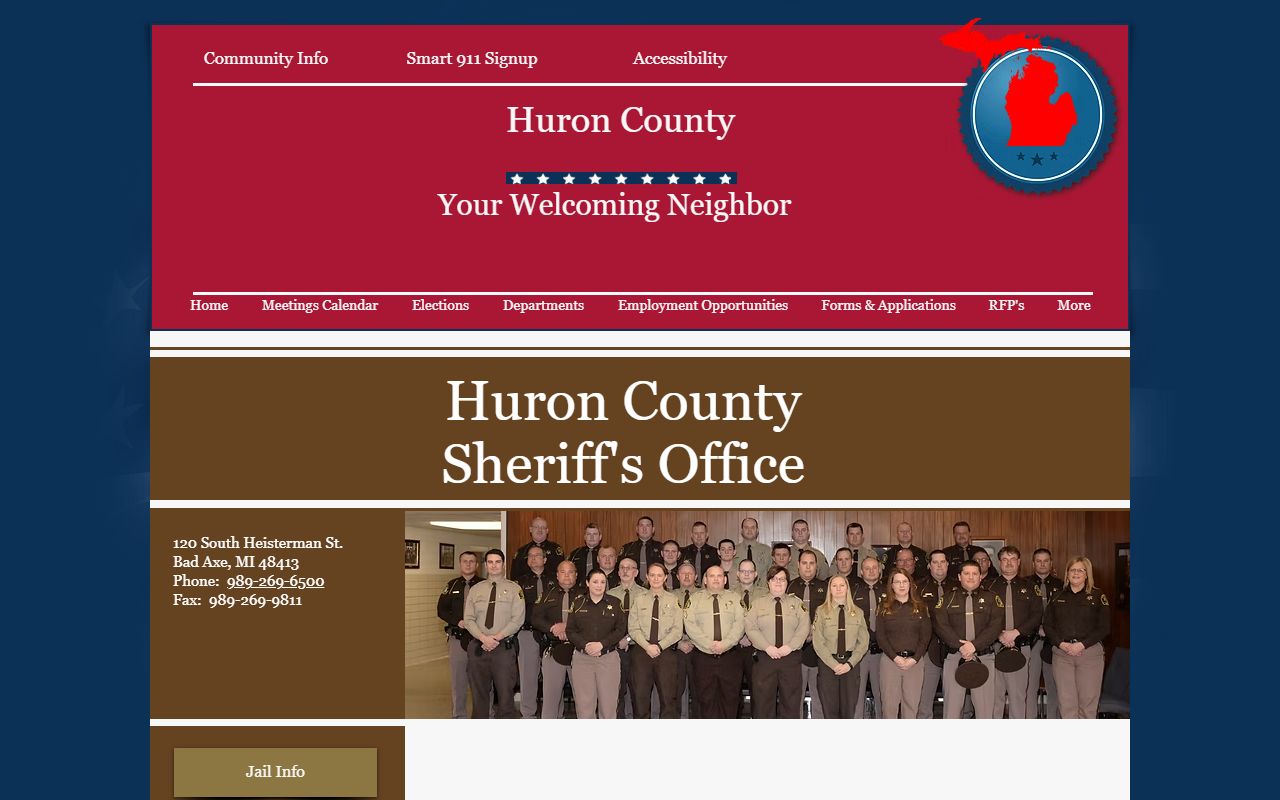
A Freedom of Information Act request form is offered by the office, though it is not required, and records can be picked up, mailed, faxed, or sent on digital media. That request route is the practical fallback for arrest-adjacent records the court index does not hold.
Note: The county posts no public arrest blotter or mugshot roster, so the court case index is the reliable way to confirm exactly what was charged.
How Huron County Charges Get Filed
The charge record starts when the prosecutor files a charging document. In Michigan, three types do this work. A complaint is the common starting point, and it states the charge under oath. Felonies begin in district court, where a judge or magistrate holds a preliminary exam. If the case is bound over, the prosecutor files an information in circuit court. An indictment comes from a grand jury and is rare in county practice. The table sums up who files each one and when it is used.
| Complaint | Information | Indictment | |
|---|---|---|---|
| Filed By | Officer or prosecutor | Prosecutor | Grand jury |
| Common For | Misdemeanors and first felony charges | Felonies after bindover | Serious felonies |
| Court | District Court | Circuit Court | Circuit Court |
| Michigan Use | Starts most cases | Follows a preliminary exam | Uncommon locally |
The prosecutor decides which charges to bring, not the arresting officer. That review can add counts, drop weak ones, or pick a lower charge than the arrest suggested. Huron County does not publish a separate prosecutor landing page in its official materials, so criminal charges are tracked through the district and circuit court files rather than a stand-alone charging portal. Felony matters start in district court for a preliminary exam and then move to circuit court once bound over.
Charge Status in Huron County Records
Charges do not stay frozen. As a case moves, a prosecutor may amend a count, reduce it, add one, or drop it. A judge may dismiss a charge. The court index shows the current status next to each count, so a charge listed at arrest may read differently later. The terms below appear often in Huron County charge records.
| Status | What It Means |
|---|---|
| Pending | The charge is filed and the case is still open, with no verdict or plea yet. |
| Amended / Reduced | The prosecutor changed the count, often to a lesser offense than the first charge. |
| Dismissed | A judge ended the charge, so it does not proceed to a verdict. |
| Nolle Prosequi | The prosecutor chose to drop the charge and not pursue it further. |
Note: A charge shown at booking can change by the next hearing, so always check the current status in the court index before drawing any conclusion.
Charges vs. Convictions
A charge is an accusation, not a finding of guilt. Being charged means a prosecutor believes there is enough cause to bring the matter to court. A conviction comes only after a plea or a verdict. Many charges never reach a conviction. Some are reduced, and some are dropped. Reading a charge record with that in mind prevents a common mistake.
| Charge | Conviction | |
|---|---|---|
| Stage | Accusation | Verdict or plea |
| Burden of Proof | Probable cause | Beyond reasonable doubt |
| Public Record | Yes | Yes |
A person is presumed innocent until a court rules otherwise. A charge record can show open counts for months while a case works through hearings. It may later show a dismissal, a plea to a lesser count, or a conviction. Reading only the arrest or the first charge, and stopping there, gives a false picture. The final disposition tells the real result, and that sits in the full case file.
Sealed vs. Expunged Records
Some records leave public view over time. Michigan law lets certain convictions be set aside, or expunged, under the state expungement statute (MCL 780.621). A sealed record is hidden from public search but still exists for limited official use. An expunged record is treated as though it never happened for most purposes. Eligibility turns on the offense, the number of prior matters, and the time that has passed.
| Sealed | Expunged | |
|---|---|---|
| Visibility | Hidden from public search | Treated as if it never existed |
| Law Enforcement | Limited access | Very limited access |
| Eligibility | Court order under court rule | Set-aside under MCL 780.621, by offense and waiting period |
Huron County Charge Codes and Severity Levels
Each charge ties to a specific statute, and that code sets its severity. Michigan sorts offenses into felonies, misdemeanors, and civil infractions. Felonies carry the most serious penalties and route to circuit court. Misdemeanors stay in district court and carry lighter jail limits. Civil infractions, like many traffic matters, are not crimes at all. One arrest can produce several separate charges, each with its own code and level. A charge record lists every count, not just the top one.
The level of each charge shapes where it is heard and how it is scored. A felony code points to circuit court and a longer possible term. A misdemeanor code stays in district court with a shorter jail cap. Reading the code and the level together shows how serious the county treats a given count. When the count is amended, the new code and level replace the old ones in the record.
Statewide Charge and Criminal History Lookups
Charges also roll up into statewide systems. The Michigan State Police keeps the state criminal history record, searchable through its ICHAT service. A name-based search there returns public criminal history for a fee. The state also publishes a separate public lookup for registered offenders.
The Michigan sex offender registry lets anyone check whether a person is a registered offender in the state.
That registry is a statewide tool, not a Huron County list, and it is one more channel beyond the local court index. What can be released, and to whom, is governed by Michigan's criminal history dissemination law (MCL 28.243).
Note: Statewide systems pull from many counties at once, so a Huron County charge may also surface in the state criminal history record over time.
Background Check Considerations
A casual name search is not the same as a formal background check. Employers, landlords, and licensing bodies that run screening must follow the federal Fair Credit Reporting Act. Those checks come from regulated agencies and carry legal duties. A quick look at a court index does not. The difference matters when a charge record is used to make a decision about a person.
Important: This site is not a consumer reporting agency under the FCRA, and its information cannot be used for employment, housing, credit, or any other FCRA-regulated purpose.
Restricted Charge Records in Huron County
Not every charge record is open to the public. Juvenile charges are shielded under Michigan's juvenile records statute (MCL 712A.28), and they do not follow the adult release pattern. Expunged and set-aside matters drop out of public view. Nonpublic court records require a statute, a court rule, or a party's release with court-verified identity, and that request must be signed in person at the court. FOIA requests to county offices can also be denied in part when an exemption (MCL 15.243) applies.
The Michigan Attorney General publishes plain guidance on how the state Freedom of Information Act works.
That guidance helps when a request for arrest-adjacent records is filed with the sheriff or a county office. It explains what can be sought, how offices respond, and when an exemption may limit release.