
Criminal Court Records in Huron County
Every criminal case in the county builds a written file. That file opens the moment a prosecutor files a charge, and it grows with each event that follows. The clerk of court keeps the file for the trial courts, and the county clerk also processes circuit court records. A Huron County criminal court record is case-level. It follows one defendant and one set of charges from the first filing through the final ruling. This makes it broader than a single arrest entry. For a closer look at the charges themselves, the complaint, and the charge codes, the county's arrest records and court charges cover that side in more detail.
Two trial courts handle criminal matters in Huron County. The 73B District Court hears misdemeanors, which carry a maximum penalty of up to one year in jail. It also holds preliminary examinations in felony cases. When a district judge finds probable cause, the felony is bound over to the Circuit Court. The Circuit Court hears all felony cases and passes sentence on them. Both courts sit in the county building in Bad Axe. Because a felony can begin in one court and finish in another, its record may span two case files.
How to Search Huron County Criminal Court Records
Most Huron County criminal court records start with the statewide MiCOURT case search. This public portal covers circuit, district, and probate cases across Michigan, so a Huron County matter appears in the same system as cases from other counties. Searches run by defendant name or by case number. Filters let a user narrow by court, case type, filing year, status, and judge.
- Open the MiCOURT case search and choose to search by name or by case number.
- Enter the defendant's first and last name, or type the case number if you already have it.
- Narrow the results by court, case type, and filing year to reach the right file.
- Open the case to read the docket entries, charges, plea, and disposition.
- Request a certified copy from the clerk of court when you need an official document.
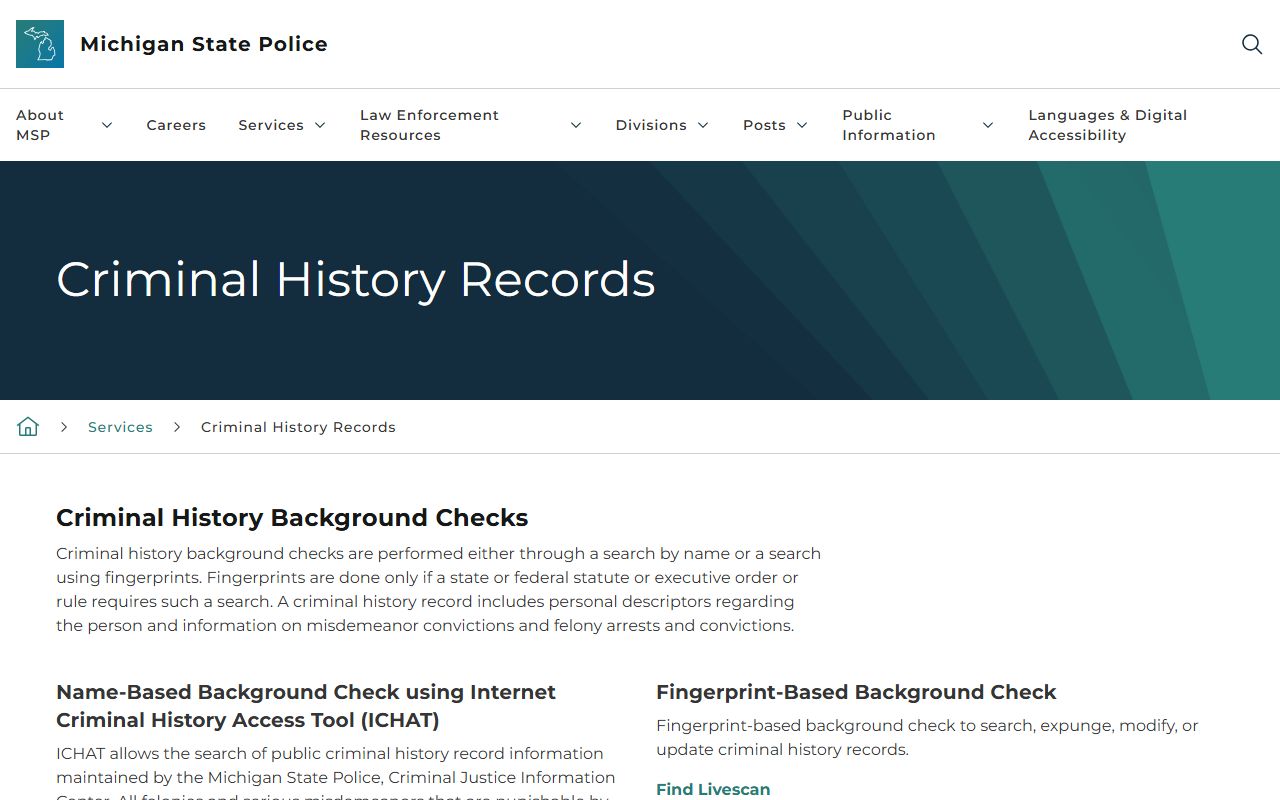
For a statewide criminal history rather than a single case file, the Michigan State Police run a public record check. The Michigan State Police criminal history resource, known as ICHAT, lets users search convictions across the state for a set fee. It pulls from records reported by police and courts statewide, not just Huron County.
The ICHAT criminal history tool is the statewide route to a person's conviction history in Michigan.
That statewide check is useful when a person may have cases in more than one county. For a single Huron County file, the local district court also offers an in-person route. An online research terminal sits on the second floor across from Room 207, open for public use. For file copies, the district court uses a record request form that sorts requests into review, copies, the whole file, or specific documents, and by case type such as criminal or traffic. Non-public records take more. The court requires a statute, a court rule, or a party's authorization, plus in-person identity verification, before it will release them.
Stages of a Huron County Criminal Case
A criminal case moves through set stages, and each one adds new entries to the court record. The docket lists these events in order, with dates and short notes. Reading the stages in sequence shows how a case reached its outcome. It also shows what is still pending when a case is open.
Case flow: Charges Filed › Arraignment › Pretrial / Motions › Plea or Trial › Disposition › Sentencing
| Stage | What Happens |
|---|---|
| Arraignment | The defendant hears the charges and enters a first plea. Bond and release terms are set here. |
| Pretrial / Motions | Both sides exchange evidence and file motions. A felony may get a preliminary exam in district court before bindover. |
| Plea or Trial | The case ends in a plea deal or goes to trial, where a judge or jury weighs the proof. |
| Sentencing | After a plea or guilty verdict, the court sets the penalty, from fines and probation to jail or prison. |
Not every case reaches every stage. Many end with a plea long before trial. Others close when the prosecutor drops the charge or the judge dismisses it. Note: a felony that starts in the 73B District Court and binds over to Circuit Court will show events under both courts in the record.
What a Huron County Criminal Court Record Shows
The county request forms and the statewide search system point to the fields a criminal file is built around. Most records center on party name, case number, and the dates that mark each event. The list below reflects what a reader can commonly work from, though not every portal shows every field.
| Field | What It Shows |
|---|---|
| Case Number | The unique number the court assigns to the file, used to pull every record in the case. |
| Defendant | The person charged, listed by name and sometimes date of birth for matching. |
| Charges | Each count filed, with the statute cited and the severity, such as misdemeanor or felony. |
| Plea | How the defendant answered each charge, whether guilty, not guilty, or no contest. |
| Disposition | How the charge ended, from a conviction or acquittal to a dismissal. |
| Sentence | The penalty imposed, such as fines, probation, jail, or prison time. |
Michigan court rules keep some personal data out of the public view. Dates of birth, Social Security numbers, driver license numbers, and financial account numbers are shielded or redacted. A reader may see the case entry and the charge without seeing every private detail behind it.
Charges vs. Convictions
Being charged is not the same as being convicted. A charge is only an accusation that the prosecutor must still prove. A conviction means a court found the defendant guilty, by plea or by verdict. A Huron County criminal court record can show charges that were later dropped, dismissed, or ended in an acquittal. Reading a file as if every charge were a conviction is a common mistake.
| Charge | Conviction | |
|---|---|---|
| Stage | Accusation | Verdict or plea |
| Burden of Proof | Probable cause | Beyond reasonable doubt |
| Can Change | Amended, reduced, or dropped | Final unless appealed |
| Public Record | Yes | Yes |
The gap matters for anyone reading a record for hiring, housing, or a personal check. A dismissed charge is not proof of guilt. The full case file, and its disposition line, tell the real outcome.
Reading Dispositions and Sentences
The disposition is the line that tells how a charge ended. Common entries include guilty, not guilty, dismissed, and no contest, which is also called nolo contendere. A no contest plea accepts the penalty without admitting guilt. Some cases show a deferred or delayed status, where a judge holds judgment while the defendant meets set terms. If those terms are met, the charge may close without a conviction on the record.
The sentence sits next to the disposition. It spells out the penalty the court imposed. A sentence may mix several parts, such as fines, court costs, probation, and jail or prison time. The record notes the length of any term and any conditions, like treatment or restitution. For felony sentences handed down in the Circuit Court, the file shows the count, the plea or verdict on each, and the term set for each one.
Sealed vs. Expunged Huron County Records
Not every criminal record stays public forever. Michigan law lets some people clear a past conviction from public view. A sealed record is hidden from public searches but still exists for limited official use. An expunged record, often called a set aside in Michigan, is treated as though the conviction never happened. The expungement statute, MCL 780.621, sets who qualifies and how the process works.
The full text of the Michigan expungement statute lays out the waiting periods and the offenses that can be set aside.
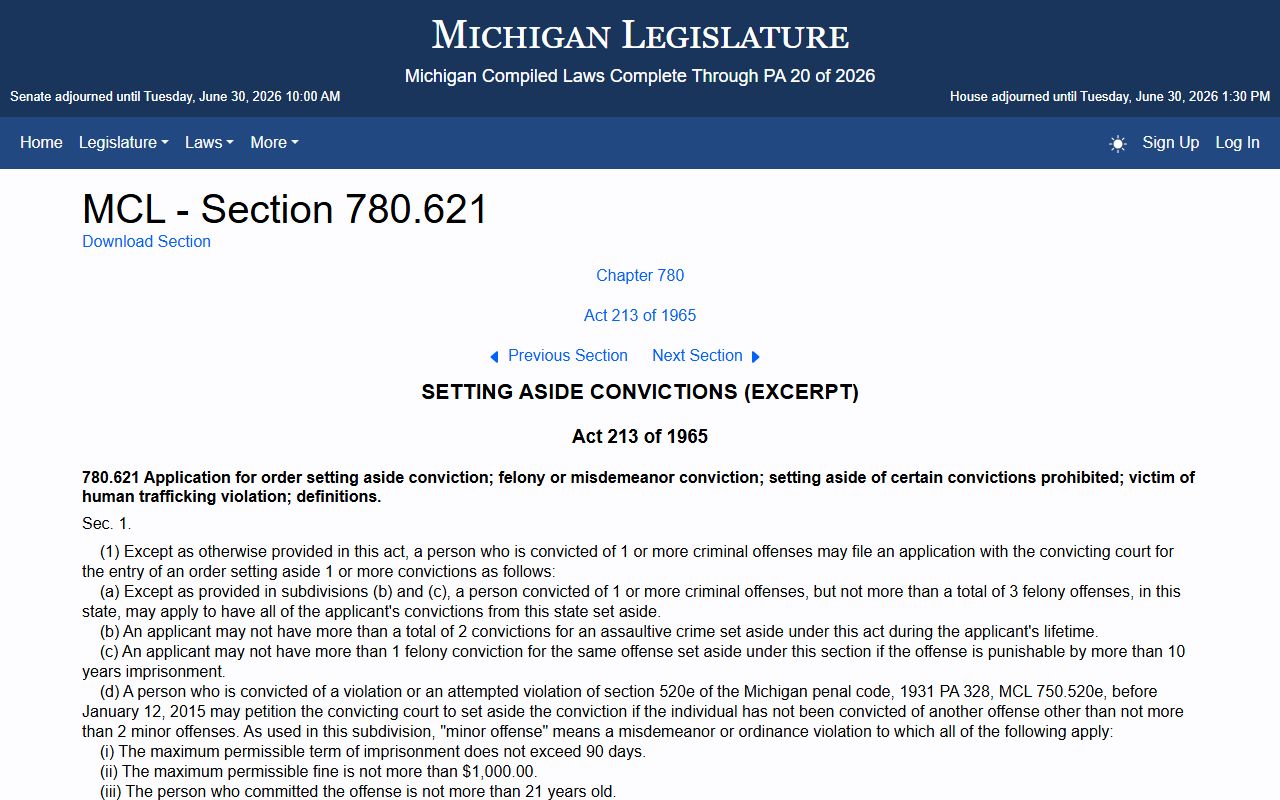
Because of this law, a search page cannot promise that every charge or conviction stays visible for good. A record that appeared last year may be gone after a set aside is granted. The table below shows how the two outcomes differ in practice.
| Sealed | Expunged | |
|---|---|---|
| Visibility | Hidden from public | Treated as if it never existed |
| Law Enforcement | Limited access | Very limited access |
| Eligibility | Set by court order and rule | Set aside under MCL 780.621 after waiting periods |
Public Access to Huron County Criminal Records
Court records in Michigan are generally open to the public. That right comes from the state's court rules and its open-records laws, though sensitive personal data stays redacted. Criminal case files fall under this rule, so most dockets, charges, and dispositions can be read by anyone. The county's full court records follow the same access framework across civil, family, and probate matters. Release of a person's criminal history has its own rules, since that data moves between agencies.
Key Statutes:
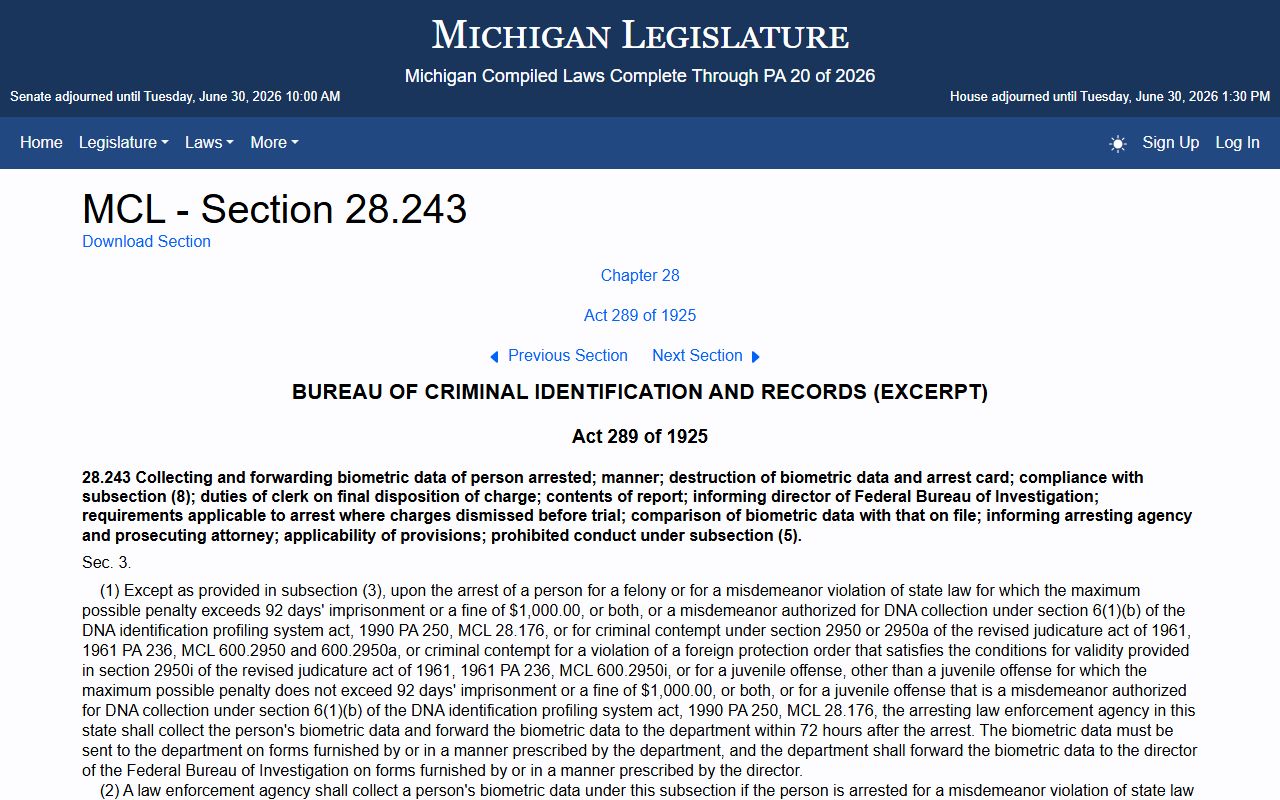
MCL 28.243 - governs how criminal history record information is shared and who may receive it.
MCL 15.243 - lists the Freedom of Information Act exemptions that let an office withhold parts of a record.
The rules on sharing criminal history data are set out in full in the statute itself.
The criminal history dissemination statute controls how the state releases a person's record beyond the court file.
These laws work together. The court rules keep the case file open, FOIA covers records held by county offices, and the dissemination statute controls the wider spread of criminal history data. Note: a public record request for a non-public court file needs a statute, a rule, or party authorization, plus in-person identity verification at the court.
Background Check Considerations
A casual name search is not the same as a formal background check. Employers, landlords, and others who screen people for regulated purposes must follow the federal Fair Credit Reporting Act. That law sets rules for accuracy, notice, and consent. A quick lookup on a public court portal does not meet those standards, and neither does a general records site. For hiring or tenant decisions, a licensed screening service is the proper route.
Important: This site is not a consumer reporting agency under the Fair Credit Reporting Act, and its records may not be used for credit, employment, tenant, or insurance decisions.
Restricted Criminal Court Records in Huron County
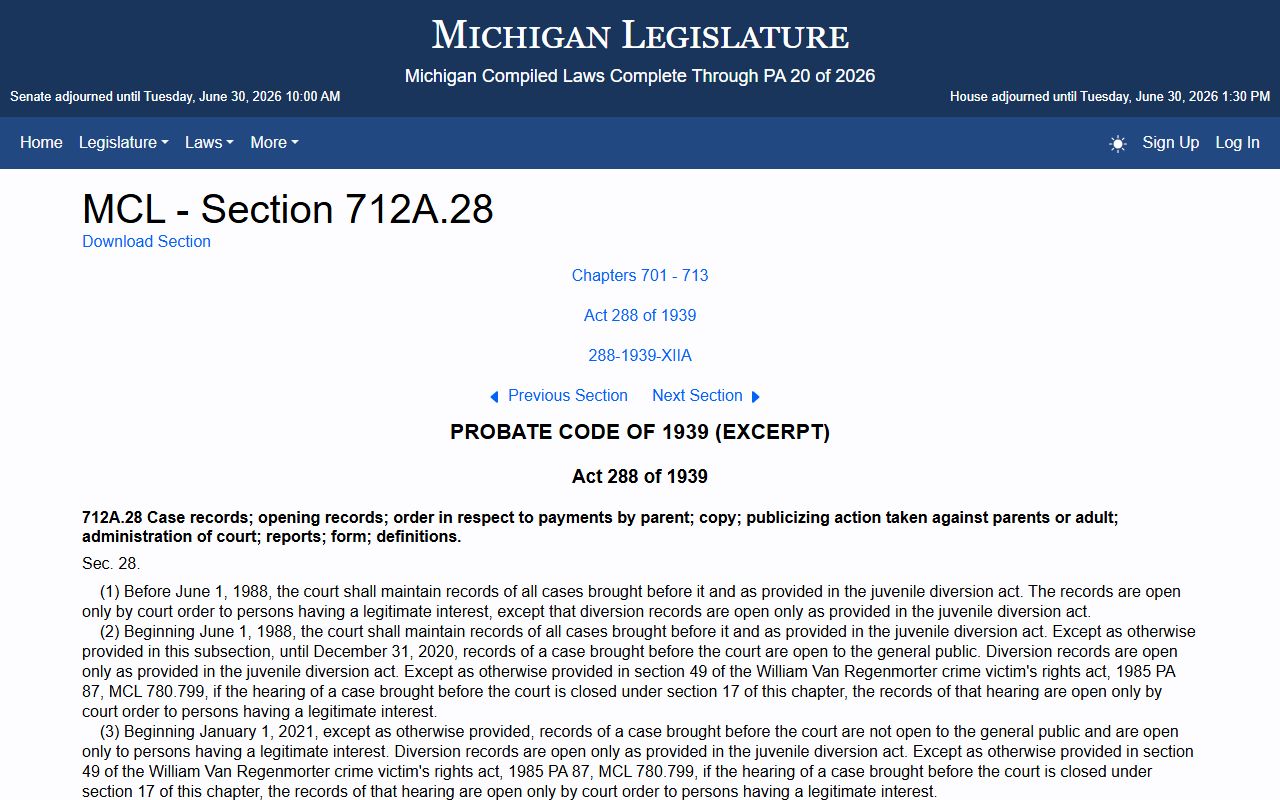
Some criminal court records are closed or limited by law. Juvenile cases are the clearest example. Records for young people carry special protection, so they do not follow the same release pattern as adult files. The juvenile records statute, MCL 712A.28, sets how these files are kept and who may see them. Family division matters like delinquency, abuse, and neglect often fall under this shield.
The rules for keeping and viewing youth files appear in the statute in detail.
The juvenile records statute explains why a young person's case is not treated like an ordinary adult record.
Other records stay restricted for different reasons. Sealed and expunged cases drop out of public view. Ongoing matters may hold back parts of a file until the case closes. Personal identifiers are redacted under the court rules. Anyone tracking a warrant or a person in custody should note that those details live in the county's warrant and jail channels rather than in the closed court file. When a record is withheld, the court will point to the statute or rule that requires it.